





What is mobile app testing?

Overview
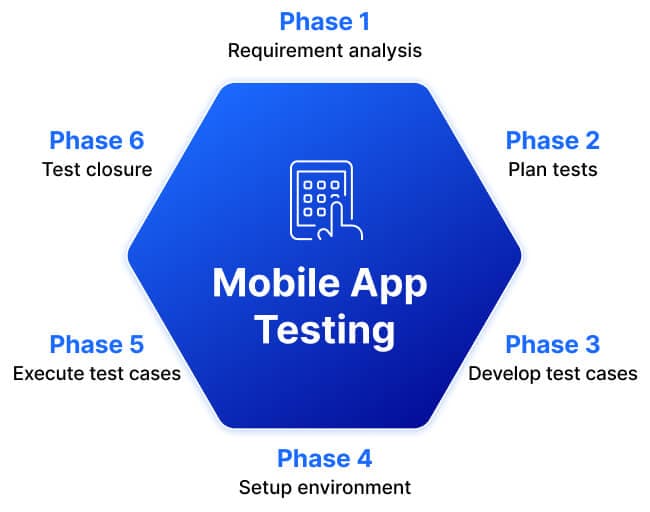
Mobile app testing
How does mobile app testing work?
It involves a comprehensive evaluation of an application's performance, functionality, security, and usability. By simulating real-world user interactions, testers identify defects, inconsistencies, and areas for improvement. The process spans from initial concept validations to rigorous final-stage assessments, ensuring that every app release is robust and user-ready.
Testers explore multiple dimensions of an app including:
- Assessing functionality against specifications.
- Examining user interactions to guarantee intuitive experiences.
- Inspecting performance under various environmental conditions.
This iterative mobile app testing process not only refines technical aspects of the app but also builds confidence in its overall market readiness.
What are the benefits for seamless delivery?
Mobile app testing is essential for delivering quality applications that meet user expectations and business objectives. Implementing comprehensive testing strategies protects your investment and ensures a competitive advantage in today's mobile-first marketplace.
Below are some of the benefits of implementing mobile app testing into your strategy:
- Risk mitigation: Catch critical bugs and crashes before users do. Prevent negative reviews and user churn that damage your brand reputation.
- Superior user experience: Ensure smooth performance across different devices, screen sizes, and OS versions. Keep users engaged instead of frustrated and ready to delete your app.
- Cost efficiency: Fix bugs during development rather than scrambling to patch issues after launch. Reduce support tickets and long-term maintenance headaches.
- Market competitiveness: Earn higher ratings and more downloads through quality. Stand out in app stores where users compare options in seconds.
- Security protection: Find vulnerabilities before hackers do. Protect user data and maintain compliance with platform rules and regulations—avoid rejections or legal troubles.
- Business continuity: Maintain consistent functionality through updates without breaking existing features. Build trust and keep revenue flowing with reliable performance.
It isn't overhead, it's a strategic investment in quality, user satisfaction, and long-term success. By integrating comprehensive testing into your development process, you protect your brand, reduce costs, and deliver experiences that users love and recommend.
What are some common challenges testers face?
While it delivers significant value, implementation comes with real obstacles. Understanding these challenges helps teams prepare realistic strategies and allocate resources effectively. Key challenges include:
- Device fragmentation: Navigate thousands of device models, screen sizes, and OS versions. Test across the combinations that matter most to your user base without burning resources on every possible configuration.
- Time and resource constraints: Balance thorough testing with tight release schedules and limited budgets. Prioritize critical test cases and automate repetitive tasks to maximize coverage efficiently.
- Rapidly changing technology: Keep pace with frequent OS updates, new devices, and evolving platform requirements. Adapt testing strategies quickly to avoid compatibility issues and app store rejections.
- Network variability: Account for different connection speeds, bandwidth limitations, and offline scenarios. Ensure your app performs well on 5G, spotty Wi-Fi, and everything in between.
- Test environment complexity: Set up and maintain realistic testing environments that mirror real-world conditions. Manage emulators, simulators, and physical device labs effectively.
- Automation challenges: Build reliable automated tests that don't require constant maintenance. Deal with flaky tests, UI changes, and framework limitations that slow down CI/CD pipelines.
These challenges are real but manageable with the right approach. Successful teams combine strategic planning, smart tool selection, and continuous learning to build testing practices that scale. The key is starting with what matters most to your users and refining your strategy as you go.
So, how can you implement mobile app testing into your current strategy?
Robust testing is vital for ensuring quality in application and software delivery. It encompasses various testing disciplines, with functional and performance testing being two pivotal components:
Functional testing: Validates that the app behaves as intended, strictly adhering to predefined requirements and user scenarios. This includes:
- Verify user interface elements for correctness.
- Confirm navigation flows and logical consistency.
- Execute test cases that mirror realistic user interactions.
- Detect defects in features and data processing.
Performance testing: Measures the app’s responsiveness, stability, and resource efficiency during varied loads and stress situations. This involves:
- Simulating peak user traffic to assess load capabilities.
- Measuring response times to ensure swift interactions.
- Evaluating resource utilization under stress conditions.
- Monitoring the app’s stability during extended usage sessions.
Combining both functional and performance testing ensures that an app not only meets requirements but also scales gracefully under real-world pressures.
Can testing mobile applications be enhanced by AI-driven test automation?
The advent of AI and automation has fundamentally transformed mobile app testing, delivering unprecedented speed, precision, and intelligence. Modern AI-driven frameworks leverage sophisticated machine learning algorithms that don't just execute tests, but learn from them, continuously improving their ability to identify vulnerabilities and predict potential failures before they manifest in production.
Below are some of the key benefits of testing mobile applications with AI-powered test automation:
- Automating repetitive testing tasks to run comprehensive test suites in minutes instead of days. Ship faster while maintaining quality standards and respond quickly to market changes.
- Analyzing application behavior across thousands of scenarios to spot issues human testers miss. Identify emerging defect patterns and prioritize critical bugs based on potential user impact.
- Validating each code commit automatically and giving development teams instant feedback. Catch regressions immediately before they spread through your codebase.
- Refining test cases based on application changes, user behavior, and past defects. Adjust coverage automatically, remove redundant tests, and generate new ones for modified features.
- Forecasting potential issues by analyzing code complexity, failure patterns, and performance metrics. Address vulnerabilities before deployment to reduce post-release incidents and improve user satisfaction.
As AI-driven frameworks mature, they're transforming mobile app testing from a reactive quality gate into a proactive intelligence system that continuously learns, adapts, and evolves, making testing faster and infinitely more scalable.
How can OpenText help accelerate your mobile application delivery?
Mobile users won't wait around for buggy apps. If you want to keep them happy, you need solid quality checks built into every release: quick feedback loops, testing across a wide range of devices, and less back-and-forth between teams. Good mobile testing catches problems early, keeps your pace steady, and gives you real confidence before anything goes live.
OpenText functional testing solutions help you build, automate, and manage meaningful tests for your mobile apps. Create flows without writing code, lean on AI for assistance, and reuse whatever you've built across different browsers, devices and emulators. Run tests simultaneously to cover more ground without blowing through your budget. Grab videos, logs, and diagnostic data to troubleshoot faster. Plug into your CI pipeline to spot issues sooner, speed up approvals, and release features that work.
OpenText performance engineering solutions put your mobile app through real-world stress tests by throwing peak traffic and sudden surges at it. Mimic different networks and locations to find the slowdowns your users will hit. Monitor results as they happen to track down problems, optimize your infrastructure, and shore up your services before launch. If compliance demands it, you can run secure tests outside the cloud while still getting deep insights.
At the end of the day, if you aren’t testing your mobile applications, you should be. It’s the backbone of a successful launch, ensuring every detail contributes to a cohesive, high-quality user experience. From nuanced benefits, challenges, and the incorporation of AI-based methods, testing transforms raw code into compelling, user-centric applications. As technology continues to push boundaries, staying ahead with robust testing strategies will fuel future innovations and end-user delight.
Resources
-
Santander Brazil
Supporting faster, more automated, and more thorough testing of mobile banking apps at significantly lower cost with OpenText
-
Ntrance
Mobile gaming studio supports responsive and reliable interactions between tens of thousands of simultaneous players with performance testing from OpenText™ Professional Performance Engineering
-
A leading sharia-compliant bank
Saving time and effort in software testing with OpenText™ Professional Performance Engineering, OpenText™ Functional Testing, and OpenText™ Functional Testing Lab for Mobile and Web
-
Independent Health
Reduce mobile test maintenance by 35% while rapidly managing application changes with OpenText™ Functional Testing AI-based capabilities
-
Amdocs
Quality engineering leader integrates with OpenText solutions
-
Shanghai OnStar Telematics Co
On the journey to DevOps, Shanghai OnStar deploys OpenText™ Functional Testing Lab for Mobile and Web, integrated with OpenText™ Application Quality Management, BPT and OpenText™ Functional Testing to automate testing of lifesaving mobile app


