Why OpenText
Why OpenText
Overview Why OpenText
OpenText brings decades of expertise to help you unlock data, connect people and processes, and fuel AI with trust
Manage and connect data
Unify data seamlessly across your enterprise to eliminate silos, improve collaboration, and reduce risks
AI-ready information
Get AI-ready and transform your data into structured, accessible, optimized information
Built-in security and compliance
Meet regulatory and compliance requirements and protect your information throughout its lifecycle
Empowering people
Overview Empowering people
OpenText helps people manage content, automate work, use AI, and collaborate to boost productivity
Customers
See how thousands of companies around the world are succeeding with innovative solutions from OpenText
Employees
Our people are our greatest asset; they are the life of the OpenText brand and values
Corporate Responsibility
Learn how we aspire to advance societal goals and accelerate positive change
Partners
Find a highly skilled OpenText partner with the right solution to enable digital transformation
How we compare
Content Management
Service Management
Deploy anywhere
Overview Deployment options
Explore scalable and flexible deployment options for global organizations of any size
Sovereign cloud
Local control. Global scale. Trusted AI
Private cloud
Your cloud, your control
On-premises
Free up resources, optimize performance and rapidly address issues
Public cloud
Run anywhere and scale globally in the public cloud of your choice
AI leadership
Overview Aviator AI
See information in new ways
OpenText™ Aviator AI
AI that understands your business, your data, and your goals
OpenText™ MyAviator
Say hello to faster decisions. Your secure personal AI assistant is ready to get to work
OpenText™ Business Network Aviator
Gain better insights with generative AI for supply chains
OpenText™ Content Aviator
Power work with AI content management and an intelligent AI content assistant
OpenText™ Cybersecurity Aviator
Improve your security posture with AI cybersecurity and agile threat detection
OpenText™ DevOps Aviator
Enable faster app delivery, development, and automated software testing
OpenText™ Experience Aviator
Elevate customer communications and experiences for customer success
OpenText™ Service Management Aviator
Empower users, service agents, and IT staff to find the answers they need
Aviator AI
Overview Aviator AI
See information in new ways
OpenText™ Aviator AI
AI that understands your business, your data, and your goals
OpenText™ MyAviator
Say hello to faster decisions. Your secure personal AI assistant is ready to get to work
OpenText™ Business Network Aviator
Gain better insights with generative AI for supply chains
OpenText™ Content Aviator
Power work with AI content management and an intelligent AI content assistant
OpenText™ Cybersecurity Aviator
Improve your security posture with AI cybersecurity and agile threat detection
OpenText™ DevOps Aviator
Enable faster app delivery, development, and automated software testing
OpenText™ Experience Aviator
Elevate customer communications and experiences for customer success
OpenText™ Service Management Aviator
Empower users, service agents, and IT staff to find the answers they need
Analytics
Overview Analytics
Predict, act, and win with real-time analytics on a smarter data platform
OpenText™ Aviator Search(AI)
Give users access to the answers they need, faster and easier, with multi-repository AI-based search that lets you contextualize everything from clicks to conversations
Business Network
Overview Business Network
Connect once, reach anything with a secure B2B integration platform
Content
Overview Content
Reimagine knowledge with AI-ready content management solutions
OpenText™ Content Aviator(AI)
Supercharge intelligent workspaces with AI to modernize work
Cybersecurity
Overview Cybersecurity
Integrated cybersecurity solutions for enterprise protection
OpenText Cybersecurity for SMBs & MSPs
Purpose built data protection and security solutions
OpenText™ Cybersecurity Aviator(AI)
Reinvent threat hunting to improve security posture with the power of agile AI
DevOps
Overview DevOps
Ship better software—faster—with AI-driven DevOps automation, testing, and quality
Experience
Overview Experience
Reimagine conversations with unforgettable customer experiences
Observability and Service Management
Overview Observability and Service Management
Get the clarity needed to cut the cost and complexity of IT operations
OpenText™ Service Management Aviator(AI)
Redefine Tier 1 business support functions with self-service capabilities from private generative AI
APIs
Overview APIs
Build custom applications using proven OpenText Information Management technology
OpenText™ API Services
Build it your way with OpenText Cloud APIs that create the real-time information flows that enable custom applications and workflows
Device and Data Protection
Overview Device and Data Protection
Protect what matters, recover when it counts
Unified Endpoint Management Tools
- OpenText™ Endpoint Management
- OpenText™ ZENworks Suite
- OpenText™ ZENworks Service Desk
- OpenText™ ZENworks Configuration Management
- OpenText™ ZENworks Endpoint Security Management
- OpenText™ ZENworks Full Disk Encryption
- OpenText™ ZENworks Endpoint Software Patch Management
- OpenText™ ZENworks Asset Management
Solutions
Trusted Data & AI
Overview Trusted Data & AI
Secure information management meets trusted AI
OpenText AI Data Platform
A unified data framework to elevate data and AI trust
OpenText Aviator Studio
A place where you can build, deploy, and iterate on agents in your data's language
OpenText Discovery
A set of tools to help ingest data and automate metadata tagging to fuel AI
OpenText Data Compliance
A suite of services and APIs that make governance proactive and persistent
OpenText Aviator AI Services
Professional services experts who help you on your AI journey
Information Reimagined
Overview Information Reimagined
Get greater visibility and sharper insights from AI-driven information management. Ready to see how?
Knowledge reimagined
Transform daily work with enterprise content management powered by AI
Service Management reimagined
Cut the cost and complexity of IT service management, AIOps, and observability
Connections reimagined
AI-powered B2B integration for supply chain success
Conversations reimagined
Drive value, growth, and loyalty with connected customer experiences
Engineering reimagined
Agile development and software delivery? It only seems impossible
Security reimagined
Cybersecurity for the Enterprise
Decisions reimagined
Unlock insights with AI data analytics
Artificial Intelligence
Overview Aviator AI
See information in new ways
OpenText™ Aviator AI
AI that understands your business, your data, and your goals
OpenText™ MyAviator
Say hello to faster decisions. Your secure personal AI assistant is ready to get to work
OpenText™ Business Network Aviator
Gain better insights with generative AI for supply chains
OpenText™ Content Aviator
Power work with AI content management and an intelligent AI content assistant
OpenText™ Cybersecurity Aviator
Improve your security posture with AI cybersecurity and agile threat detection
OpenText™ DevOps Aviator
Enable faster app delivery, development, and automated software testing
OpenText™ Experience Aviator
Elevate customer communications and experiences for customer success
OpenText™ Service Management Aviator
Empower users, service agents, and IT staff to find the answers they need
Industry
Overview Industry solutions
Improve efficiency, security, and customer satisfaction with OpenText
Energy and resources
Transform energy and resources operations with cloud, cybersecurity, and AI
Financial services
Boost customer experience, compliance, and efficiency with AI
Government
Reimagine your mission with government-secure information management
Healthcare and life sciences
Improve care delivery and patient engagement with AI-powered solutions
Legal
Modernize legal teams with automated, AI-powered legal tech solutions
Manufacturing
Modernize manufacturing operations and logistics to reduce costs and ensure compliance
Retail and consumer goods
Enhance consumer engagement with omnichannel retail solutions and AI
Enterprise Application
Overview Solutions for Enterprise Applications
Run processes faster and with less risk

Maximize sustained growth, value, and innovation with intelligent enterprise solutions from OpenText and SAP


Optimize Salesforce effectiveness by bringing together transactional data and unstructured content
Services
Services
Overview Services
Achieve digital transformation with guidance from certified experts
Professional Services
Modernize your information management with certified experts
Customer Success Services
Meet business goals with expert guidance, managed services, and more
Support Services
Turn support into your strategic advantage
Managed Services
Free up your internal teams with expert IT service management
Learning Services
Discover training options to help users of all skill levels effectively adopt and use OpenText products
Professional Services
Overview Professional Services
Modernize your information management with certified experts
Customer Success Services
Overview Customer Success Services
Meet business goals with expert guidance, managed services, and more
Support Services
Overview Support Services
Turn support into your strategic advantage
Managed Services
Overview Managed Services
Free up your internal teams with expert IT service management
Learning Services
Overview Learning Services
Discover training options to help users of all skill levels effectively adopt and use OpenText products
Partners
Find a Partner
Overview Find a partner
Information is the heartbeat of every organization. We build information management software so you can build the future

Cloud Partners
Overview Cloud Partners
OpenText partners with leading cloud infrastructure providers to offer the flexibility to run OpenText solutions anywhere

Optimize performance and reduce costs with applications deployed on a secure, globally scaled platform

Accelerate migration and modernization with deployment in a highly secure and compliant public cloud
Enterprise Application Partners
Overview Enterprise Application Partners
OpenText partners with top enterprise app providers to unlock unstructured content for better business insights
Maximize sustained growth, value, and innovation with intelligent enterprise solutions from OpenText and SAP
Optimize Salesforce effectiveness by bringing together transactional data and unstructured content
Partner Solutions
Overview Partner Solutions
Discover flexible and innovative offerings designed to add value to OpenText solutions
Resources for Partners
Overview Resources for Partners
Discover the resources available to support and grow Partner capabilities
Support
Overview Customer Support
Get expert product and service support to accelerate issue resolution and keep business flows running efficiently
Resources
Overview Resources
Explore detailed services and consulting presentations, briefs, documentation and other resources
Choose your region:
Europe, Middle East and Africa
Asia–Pacific
What is model-based testing?

Overview
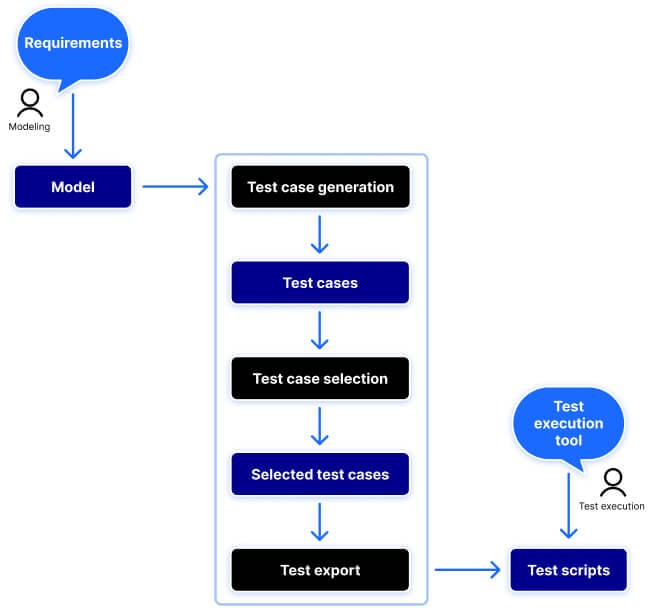
Model-based testing
How does model-based testing work?
MBT follows a systematic three-stage process that helps teams deliver higher quality software faster:
Model creation: Testing teams build a visual representation of how the system should work, capturing key functionality, user workflows, and business logic. This model maps out the system’s states, how users move between them, and what happens at each step. Teams can use familiar techniques like UML diagrams, state machines, flowcharts, or decision tables whatever works best for their context. The real value here is creating a shared understanding of expected behavior that everyone from developers to business analysts can reference. Models can focus on big-picture business processes or zoom into specific component details, depending on what needs testing.
Test case generation: Here’s where the efficiency gains really kick in. Smart algorithms analyze your model and automatically generate test cases that would take weeks to write manually. The system explores every path, transition, and decision point to create scenarios covering normal workflows, edge cases, boundary conditions, and error handling. You get comprehensive coverage without the tedious manual work, and you can tune the generation to focus on high-risk areas or specific coverage goals that matter most to your release quality.
Test execution: The generated tests run automatically against your actual system through testing frameworks that interact with UIs, APIs, or other interfaces. As tests execute, the framework compares what actually happens against what the model says should happen. When something doesn’t match, you get clear reports showing exactly where the problem occurred and which part of the model it relates to. This makes debugging much faster because you can quickly pinpoint whether it’s a system bug or a modeling issue that needs adjustment.
What are the benefits of MBT?
Traditional testing methods often fall short in addressing the dynamic nature of modern software systems. By using MBT, you can leverage abstract models to represent the desired behavior of a system for a systematic and efficient approach to validate software functionality.
Key benefits that make model-based testing in software engineering a powerful tool for software developers and testers include:
- Enhanced test coverage: Generate test cases from models that capture all possible behaviors of the system, ensuring comprehensive coverage and uncovering edge cases that manual testing might miss.
- Improved efficiency: Automate the generation of test cases and significantly reduce the time and effort required for test design, allowing testers to focus on test execution and analysis.
- Better consistency and accuracy: Eliminate human errors and inconsistencies with automated test case generation for more reliable and accurate test cases.
- Early defect detection: Facilitate early validation of system requirements and design, enabling the detection and resolution of defects at an early stage in the development lifecycle.
What are some common challenges testers face?
Adopting this approach can enhance software testing efficiency and effectiveness, but it comes with its own set of challenges. Understanding these hurdles is essential for successfully integrating this method into your software development lifecycle.
Common challenges testers face when using this approach include:
- Learning curve: MBT requires a shift in mindset and skill set, as testers need to acquire knowledge of modeling techniques and tools.
- Initial investment: The adoption of MBT involves an initial investment in tools, training, and the creation of models, which can be a barrier for some organizations.
- Model maintenance: As the system evolves, the models need to be updated to reflect changes. This ongoing maintenance effort can be resource-intensive.
- Tool compatibility: Ensuring compatibility between model-based testing tools and the existing development and testing environment can be challenging.
How can I implement model-based testing into my software testing strategy?
MBT can be applied across various types of software testing, from functional and integration testing to performance and security testing. This versatile approach enhances testing by improving coverage, efficiency, and precision in uncovering software defects across the entire testing spectrum.
Key implementation strategies include:
- Model creation: Develop models that capture the expected behavior of the system under test (SUT). These models can be created using various modeling languages and notations, such as UML, state diagrams, or flowcharts.
- Test case generation: Use model-based testing tools to automatically generate test cases from the models. These test cases will cover different scenarios, including normal, boundary, and error conditions.
- Test execution: Execute the generated test cases using automated testing tools. MBT tools often integrate with popular test automation frameworks to facilitate seamless test execution.
- Test analysis: Analyze the results of the executed test cases to identify defects and areas for improvement. The models can also be updated based on the analysis to improve test coverage and accuracy.
Can model-based testing be enhanced by AI? If so, how?
Artificial intelligence is revolutionizing model-based testing by making it more intelligent, adaptive, and autonomous. The integration of AI with MBT creates a powerful synergy that addresses many traditional testing challenges while opening new possibilities for comprehensive quality assurance.
How AI transforms model-based testing
Intelligent model generation: AI algorithms can analyze existing application code, user interfaces, and system documentation to automatically generate initial models, significantly reducing the time and expertise required for model creation. Machine learning techniques can identify patterns in application behavior and suggest optimal model structures.
Dynamic test case optimization: AI-powered MBT tools continuously learn from test execution results to optimize future test case generation. These systems can identify which test scenarios are most likely to uncover defects based on historical data, application risk areas, and code complexity metrics.
Self-healing test automation: When applications undergo changes, AI-enhanced MBT tools can automatically adapt models and test cases without manual intervention. This self-healing capability uses computer vision and natural language processing to detect UI changes and update test scripts accordingly.
Predictive defect detection: AI algorithms analyze patterns from previous testing cycles to predict where defects are most likely to occur, allowing teams to focus testing efforts on high-risk areas and optimize resource allocation.
Key AI capabilities in modern MBT tools:
- Natural language processing: Convert requirements written in plain English into executable test models, making MBT more accessible to non-technical stakeholders.
- Visual recognition: Automatically identify and interact with UI elements across different platforms and devices.
- Anomaly detection: Identify unusual system behaviors that may indicate defects, even when they don't cause explicit test failures.
- Risk-based testing: Prioritize test execution based on AI-driven risk assessment of code changes and system components.
- Continuous learning: Improve model accuracy and test effectiveness over time through machine learning algorithms.
Organizations implementing AI-enhanced model-based testing report significant improvements in testing efficiency and software quality. The combination reduces test maintenance overhead while increasing defect detection rates. This translates to faster time-to-market, reduced testing costs, and higher customer satisfaction through more reliable software releases.
How can OpenText help transform and accelerate our testing strategy with MBT?
Accelerate your testing efforts by leveraging abstract models to automate test case generation, eliminating the time-consuming manual process and reducing the risk of human error. With model-based testing powered by [tool or platform name], you can ensure comprehensive coverage across APIs, web browsers, and user workflows, helping to catch defects early in the development cycle.
Seamless integration with DevOps pipelines and AI-driven enhancements allows your teams to maintain precision at speed, enabling faster releases without compromising quality. The result? Consistently reliable, user-centric software that supports strategic goals and strengthens customer trust.
MBT empowers teams to automatically generate high-quality test cases from behavioral models, leading to stronger test coverage, faster defect detection, and greater testing consistency. While implementation requires thoughtful planning and modeling discipline, the long-term benefits are undeniable, especially when supported by the right tools and best practices.
For organizations aiming to scale their automated functional testing, improve collaboration across teams, and deliver high-performing software, model-based testing offers a clear path forward. By adopting this approach, you position your team for lasting gains in testing efficiency, software quality, and overall delivery confidence.
Resources
Related products
OpenText™ Core Software Delivery Platform
Streamline development workflows with integrated tools that accelerate releases, improve collaboration, and deliver quality software faster
OpenText™ Functional Testing
Accelerate software delivery with automated testing that validates functionality, reduces bugs, and ensures quality releases faster
OpenText™ Functional Testing Lab for Mobile and Web
Test mobile and web apps across real devices and browsers simultaneously to deliver flawless user experiences every time
OpenText™ Functional Testing for Developers
Integrate testing into your development workflow to catch defects early, ship confidently, and maintain code quality at speed
OpenText™ Core Performance Engineering
Optimize application performance with essential load testing tools that identify bottlenecks and ensure smooth user experiences
OpenText™ Professional Performance Engineering
Enhance performance testing across complex environments to prevent slowdowns and deliver consistently fast applications under load
OpenText™ Enterprise Performance Engineering
Transform performance testing enterprise-wide with advanced analytics and automation that guarantee scalable, high-performing applications


