為什麼選擇 OpenText
為什麼選擇 OpenText
概述為什麼選擇 OpenText
OpenText 擁有數十年的專業知識,可幫助您釋放資料、連結人員和流程,並以信任推動 AI
管理和連結資料
在您的企業中無縫統一資料,消除孤島、改善協作並降低風險
具備 AI 的資訊
做好 AI 準備,並將您的資料轉化為結構化、可存取且優化的資訊
內建的安全性與合規性
滿足法規和合規要求,並讓資訊在整個生命週期中受到保護
AI 領導力
概述Aviator AI
以全新的方式查看資訊
OpenText™ Aviator™
AI 了解您的企業、您的資料與您的目標
OpenText™ Content Aviator™
利用 AI 內容管理和智能 AI 內容助手提升工作效率
OpenText™ DevOps Aviator™
加快應用程式的交付、開發和自動化軟體測試
OpenText™ Experience Aviator™
提升客戶溝通與體驗,促進客戶成功
OpenText™ Service Management Aviator™
賦能使用者、服務代理和 IT 人員,讓他們找到所需的答案
OpenText™ Trading Grid™ Aviator™
解鎖貫穿整個供應鏈的 AI 驅動知識、洞察力與引導式行動
Aviator AI
概述Aviator AI
以全新的方式查看資訊
OpenText™ Aviator™
AI 了解您的企業、您的資料與您的目標
OpenText™ Content Aviator™
利用 AI 內容管理和智能 AI 內容助手提升工作效率
OpenText™ DevOps Aviator™
加快應用程式的交付、開發和自動化軟體測試
OpenText™ Experience Aviator™
提升客戶溝通與體驗,促進客戶成功
OpenText™ Service Management Aviator™
賦能使用者、服務代理和 IT 人員,讓他們找到所需的答案
OpenText™ Trading Grid™ Aviator™
解鎖貫穿整個供應鏈的 AI 驅動知識、洞察力與引導式行動
商業網路
概述Business Network
只需連結一次,即可透過安全的 B2B 整合平台觸及任何目標
內容
概述Content
以具備 AI 的內容管理解決方案重新構想知識
DevOps
概述DevOps
利用 AI 驅動的 DevOps 自動化、測試和品質,更快速交付更優質的軟體
Experience and Fax
概述Experience and Fax
以難忘的客戶體驗重新構思對話
可觀察性與服務管理
概述Observability and Service Management
獲得所需的清晰度,以降低 IT 營運的成本和複雜性
API
概述APIs
Extend the value of your OpenText solutions by building integrations, automation and custom experiences
OpenText™ API Services
使用 OpenText Cloud API 按照您的方式構建,創建支持自訂應用程式和工作流程的即時資訊流
可信資料與 AI
概述可信資料與 AI
安全資訊管理與可信賴的 AI 相遇
OpenText™ Aviator™ Studio
一個可以使用資料語言建置、部署和迭代代理程式的地方
OpenText™ Discovery
一套用於幫助擷取資料和自動添加元資料標記的工具,以推動 AI 發展
OpenText™ Data Compliance
一套服務和 API,使治理變得主動且持久
OpenText™ Aviator™ AI Services
專業服務專家協助您踏上 AI 旅程
人工智能
概述Aviator AI
以全新的方式查看資訊
OpenText™ Aviator™
AI 了解您的企業、您的資料與您的目標
OpenText™ Content Aviator™
利用 AI 內容管理和智能 AI 內容助手提升工作效率
OpenText™ DevOps Aviator™
加快應用程式的交付、開發和自動化軟體測試
OpenText™ Experience Aviator™
提升客戶溝通與體驗,促進客戶成功
OpenText™ Service Management Aviator™
賦能使用者、服務代理和 IT 人員,讓他們找到所需的答案
OpenText™ Trading Grid™ Aviator™
解鎖貫穿整個供應鏈的 AI 驅動知識、洞察力與引導式行動






 Pick n Pay
End-to-end payment testing driven by OpenText™ Functional Testing
About Pick n Pay

-
Stores:2238
-
Headquarters:Cape Town, South Africa
-
Employees:90,000
-
Main retail lines:Grocery, home, clothing
Summary
Challenges
- Difficulty validating multiple payment methods consistently.
- Errors or fatigue when mimicking real customer actions.
- Adding new payment modes without process redesigning.
Solution
- Enabled end-to-end POS testing using a robotic arm and software automation.
- Unified validation across payment types and third-party services.
- Scalable, high-volume POS automation.
Results
 50,000 automated test scripts weekly
 Regression cycle reduced to 3.5 days
  ROI achieved in 5 months with nearly 99.9% automation
Challenges
- Difficulty validating multiple payment methods consistently
- Errors or fatigue when mimicking real customer actions
- Adding new payment modes without process redesigning
Pick n Pay, like other retailers, operates in a world where payments, fulfillment, and customer expectations evolve faster than manual testing can keep up. Every tap to pay, swipe, QR code, loyalty card transaction, and every item scanned on Zebra devices for online orders or store pickups, must work flawlessly, every time. But validating all these journeys across hundreds of stores, devices, and payment types is complex, repetitive, and prone to human error. Pick n Pay needed a way to reliably recreate real customer interactions, automate them end to end, and adapt quickly as new payment methods or fulfillment workflows were introduced.

We moved from quarterly to monthly releases—and can now release every 12 days—thanks to 24/7 automation and near 100% regression coverage. The robotic arm paid for itself in just five months!
Solution
Pick n Pay created a cost‑effective automated testing setup using a robotic arm with OpenText Functional Testing, delivering scalable, accurate, and repeatable validation of all payment methods without affecting real transactions.
Products deployed
-
OpenText™ Functional Testing
Deliver applications faster with AI-powered automated software testing
-
OpenText™ Functional Testing Lab for Mobile and Web
Develop, debug, monitor, and optimize your mobile apps from anywhere
-
OpenText™ Functional Testing for Developers
Engage your developers with integrated, automated shift-left testing
Enabled end-to-end POS testing using a robotic arm combined with OpenText Software
In physical retail stores, customers can pay using multiple methods—cash, card (tap, insert, or swipe), loyalty cards, or QR‑code payments through bank wallets. In parallel, especially in markets like South Africa where on‑demand shopping and delivery are essential, Zebra devices are used in‑store to scan and process online orders. Because these devices are critical to the order‑fulfillment process, Pick n Pay needed to include them as part of their test automation coverage.
The process revolves around automating end-to-end testing for point-of-sale transactions using a robotic arm (ARM) and OpenText Functional Testing as the control center.
The ARM interacts directly with devices by picking up cards, tapping NFC, or scanning codes. It connects to OpenText Functional Testing through an API exposed by a custom Windows application developed for the ARM. OpenText Functional Testing sends commands to the ARM and waits for confirmation before moving to the next step, ensuring accurate sequencing and removing human error.
To avoid costly hardware investments, the team implemented two mobile devices mounted on stands in the server room, positioned face to face. One device displays a dynamic QR code for each transaction, while the other scans it, accurately simulating real-world payment scenarios.
This setup is fully integrated with OpenText Functional Testing and OpenText Functional Testing Lab for Mobile and Web, enabling end-to-end testing of customer mobile payment journeys and in-store operations, including scenarios where employees use Zebra Android devices to scan products for online orders. Native integration with OpenText Functional Testing enables scripts to be executed directly on OpenText Functional Testing Lab for Mobile and Web managed environments without script modifications, simplifying execution and maintenance.
By leveraging OpenText Functional Testing together with OpenText Functional Testing Lab for Mobile and Web’s parallel execution capabilities, test suites are distributed across multiple devices simultaneously, significantly reducing regression cycles from weeks to days.
The result is a fully automated, repeatable, and reliable testing environment that mirrors production scenarios without impacting real financial data. It supports various payment methods—credit, debit, loyalty, and QR—and ensures consistent outcomes across different mobile OS versions.
By combining ARM automation, OpenText Functional Testing orchestration, and multi-tier integration, the team achieved a cost-effective, scalable solution that simplifies complex testing while maintaining accuracy and efficiency.
Unified validation across payment types and third-party services
Pick n Pay’s POS now supports added value services like airtime, electricity, fine payments, and banking‑like functions. To test these reliably, it uses OpenText Service Virtualization to simulate third‑party providers via APIs, avoiding reliance on physical devices or unavailable external services.
A single platform for scalable, end-to-end POS automation
OpenText Functional Testing is designed to work across any architecture and development language, enabling enterprise-wide automation without complexity. Teams do not need to manage integrations or data handoffs between multiple tools. A single automation platform is used consistently across the environment, with shared capabilities and reusable functions. The solution supports all major enterprise technologies, including SAP, Oracle, Java, and Python, making it suitable for even the most heterogeneous IT landscapes.
Automation can be created with minimal effort, and end-to-end business processes can be automated without additional overhead. This significantly reduces time to value and operational friction while requiring only one core skill set across teams.
Finally, OpenText Functional Testing offers flexibility in how teams work. It can operate in a fully codeless mode for broader adoption, while still allowing experienced automation engineers to extend and customize functionality quickly and efficiently when needed.
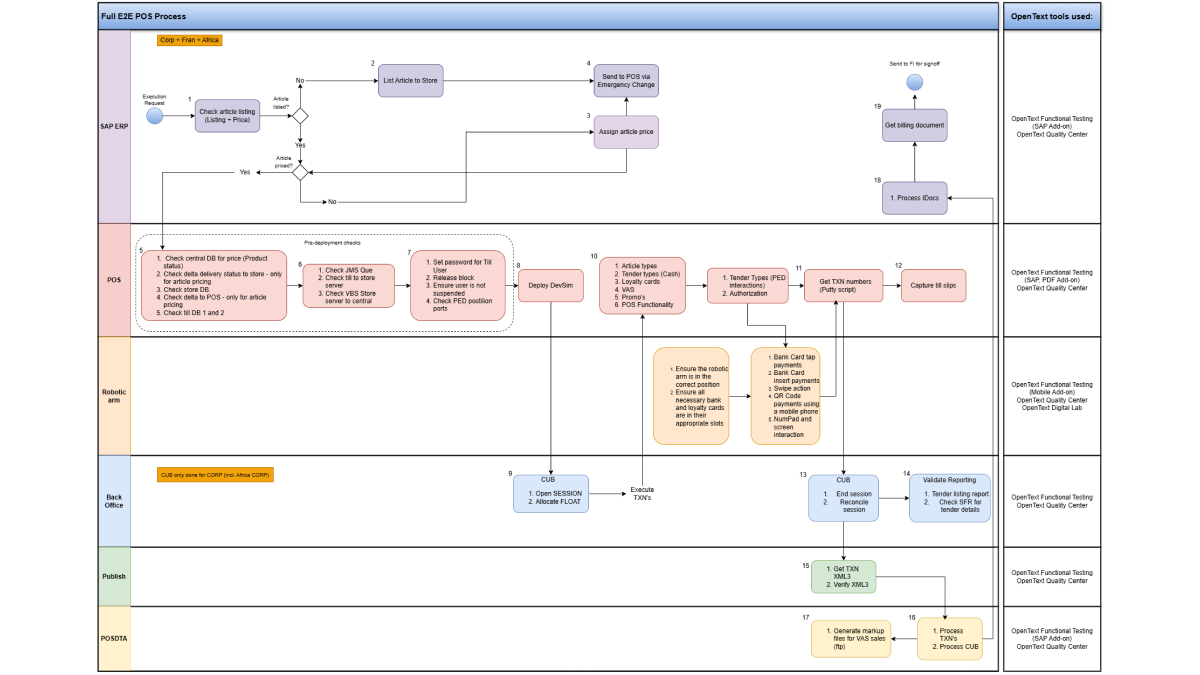
OpenText Functional Testing supports all environments and architectures, enabling seamless end-to-end automation with minimal effort. With one tool and one skill set, teams can optimize processes, create scripts easily.
Results
Pick n Pay’s small team of testers and automation engineers delivered high-volume, efficient POS testing. With nearly 100% automation coverage, they reduced regression cycles to 3.5 days, enabled monthly releases, and cut defects drastically.
A small testing team executing 50,000 automated scripts
The team started with seven or eight members but now consists of one senior software tester and two junior testers focused on point-of-sale testing. In addition, there are seven dedicated automation engineers managing robotic arm (ARM) automation. The team operates with about 17 runtime licenses and 13 full OpenText Functional Testing licenses, enabling each automation engineer to work on up to four virtual machines simultaneously. Despite its small size, the team delivers significant output, executing close to 50,000 automated scripts per week. This efficiency is also supported using OpenText Functional Testing Lab for Mobile and Web, which ensures smooth device management and eliminates latency issues, allowing the team to maintain high performance and scalability.
Nearly 100% automation coverage
The point-of-sale (POS) system now achieves full regression testing within about three and a half days per cycle, which has significantly improved release efficiency. Previously, releases occurred quarterly, averaging four per year, but the process has evolved to allow monthly releases, about twelve per year, and even the capability to release every twelve days if needed.
This improvement is largely due to the robotic arm and automation framework, which runs 24/7 and delivers nearly 100% automation coverage for regression testing. The automation team for POS is now larger than the functional testing team, enabling high-volume execution and reducing manual effort, ultimately driving faster, more reliable deployments into production.
The ROI analysis showed that the robotic arm paid for itself within five months. The total cost for the ARM included engineering, on-site setup, calibration, and installation.
Next steps
Pick n Pay’s approach for improvements is to plan thoroughly, run a small proof of concept to confirm functionality, and once validated, roll it out easily for broader use. Currently they are running a set of proof of concepts:
- First, OpenText Functional Testing for Developer is being used to test APIs and build end-to-end processes that start with mobile app transactions and validate results through backend API calls, with plans to roll it out for the Pick n Pay One app.
- Second, Postman is being leveraged for API calls because developers already use it, and its collections are integrated into OpenText Functional Testing for Developer for fully automated scenarios.
- Third, the ARM is being upgraded to become more dynamic by using OCR to analyze screenshots of the POS screen and adjust its actions, accordingly, supported by a webcam for real-time feedback.
- Finally, the team is exploring AI-driven object recognition in OpenText Functional Testing to identify screen elements from captured images and dynamically click specific areas, adding intelligence to automation for greater flexibility and adaptability. It will reduce maintenance and increase cross-platform efficiency.
Share your story
Learn more



