





Automatisation de la chaîne d'approvisionnement
Automatisez l'échange de données pour des transactions B2B sans tracas et conformes
IDC MarketScape désigne OpenText comme un quadruple leader du MESCCN. Consultez le rapport IDC.
Commencez avec l'automatisation de la chaîne d'approvisionnement
L'automatisation de la chaîne d'approvisionnement numérise les tâches répétitives et transactionnelles pour améliorer l'efficacité. OpenText regroupe ces besoins B2B sur une plateforme unique pour héberger, intégrer et gérer les flux de données, fournissant la base pour une orchestration de bout en bout future.
Connectivité mondiale
Chaque industrie et région a des normes et des protocoles de communication uniques. Obtenez une traduction et une validation universelles des formats de données via un moteur de mappage avancé pour une connectivité universelle flexible.
Mandats et réglementations sur la facturation électronique
Les organisations ont le choix : suivre les mandats évolutifs de facturation électronique ou payer des pénalités. Accédez à une plateforme qui garantit la conformité avec les réglementations nationales et les mandats de facturation électronique.
Visibilité des transactions B2B
Les systèmes fragmentés B2B/EDI ajoutent de la complexité et des coûts. Consolider en un centre de commande unique et intuitif pour rationaliser la gestion, simplifier les flux de travail et améliorer l'expérience utilisateur.
Visibilité des partenaires
Vos partenaires veulent savoir ce qui se passe en ce moment. Intégrez des partenaires EDI et non-EDI dans un système unifié qui leur permet de consulter en temps réel l'état des commandes, des expéditions et des factures.
Contrôle des données
La mise à jour manuelle des données des partenaires commerciaux et la résolution des divergences prennent beaucoup de temps. Offrez aux partenaires un accès sécurisé basé sur les rôles pour un meilleur contrôle et une résolution collaborative des problèmes.
Validation des données
Des données manquantes ou incorrectes peuvent perturber l'automatisation des processus de commande à encaissement et d'approvisionnement à paiement. La validation en temps réel propulsée par l’IA intercepte les exceptions avant qu'elles n'atteignent les systèmes internes, garantissant ainsi des flux de transactions fluides.
Les leaders font confiance à OpenText
Les leaders font confiance à OpenText




Découvrez ce que l'automatisation de la chaîne d'approvisionnement peut faire pour votre entreprise
-

Intégration B2B évolutive et sécurisée
Rationalisez et numérisez les opérations de la chaîne d'approvisionnement et renforcez l'agilité pour des transactions commerciales plus rapides et plus précises.
-

Éliminez la complexité de la conformité mondiale en matière de facturation électronique
Assurez-vous de respecter les mandats actuels et à venir de facturation électronique dans plus de 50 pays.
-

Accélérez la communication B2B sécurisée et fiable
Échangez n'importe quel document commercial, dans n'importe quel format, de manière sécurisée et efficace sur le plus grand réseau VAN EDI au monde.
-

Améliorer la qualité des données B2B avec une visibilité et des informations clés en temps réel
Renforcez la qualité des données B2B avec une visibilité de bout en bout, une validation des données en cours, des règles d'affaires flexibles et des analyses complètes.
-

Automatisez vos processus de commande à encaissement et d'approvisionnement à paiement.
Améliorez la collaboration avec les fournisseurs et rationalisez le traitement des commandes clients grâce à une tarification en temps réel pour stimuler les ventes et la satisfaction.
-

Sécuriser, gouverner et faire évoluer l'automatisation de l'IdO
Mettre en œuvre une orchestration axée sur l'identité pour appliquer une sécurité unifiée, des principes de confiance zéro et l'intégrité des données sur les appareils IdO, nécessaires à l'automatisation pilotée par l'IA.
Tirez parti de l'automatisation de la chaîne d'approvisionnement
Intégrez les personnes, les processus et les objets dans votre entreprise et chez vos partenaires commerciaux, et optimisez les processus générateurs de revenus grâce à des applications SaaS préconfigurées. Personnalisez la solution selon vos besoins en utilisant n'importe quelle combinaison des produits suivants.
-
OpenText™ Trading Grid™
Une intégration efficace commence par une plateforme de connexion intelligente.
-
OpenText™ Trading Grid™ e-Invoicing
Simplifiez la conformité de la facturation électronique pour respecter les règlements dans plus de 50 pays.
-
OpenText™ Trading Grid™ Command Center
Approfondissez l'analyse de votre chaîne d'approvisionnement grâce à un centre de commande polyvalent
-
OpenText™ Aviator™ IoT
Branchez tous vos éléments et orchestrez des données exploitables pour obtenir des résultats.
-
OpenText™ Core Product Traceability Service
Visualisez votre chaîne d'approvisionnement, connectez-vous avec vos clients et protégez votre marque.
-
OpenText™ Core Collaboration Access
Renforcer la collaboration entre partenaires commerciaux au sein de l'entreprise étendue
-
OpenText™ Core Secure Access
Renforcez la sécurité de la chaîne d'approvisionnement avec un accès sécurisé.
Découvrez comment fonctionne l'automatisation de la chaîne d'approvisionnement
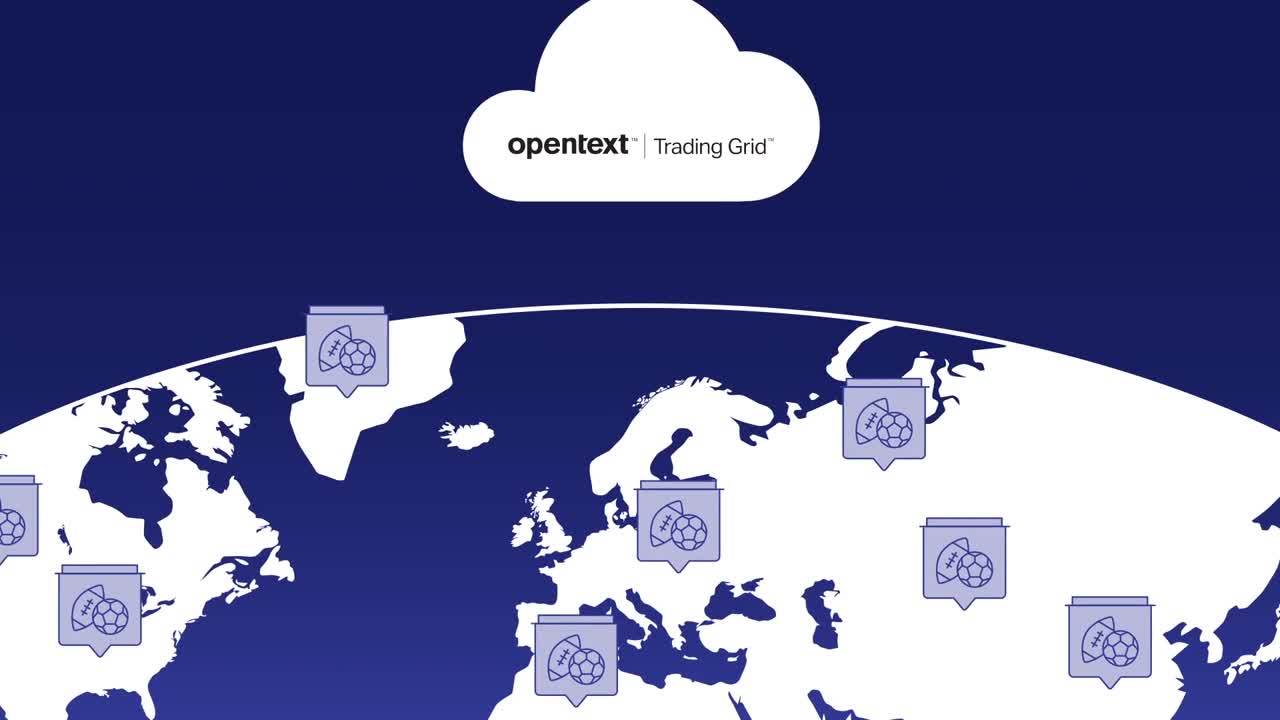
Vous souhaitez des transactions plus rapides et sans erreurs? L’automatisation prend en charge les tâches répétitives qui forment la base de votre activité. Allez plus loin avec l'orchestration de la chaîne d'approvisionnement pour atteindre une véritable coordination stratégique.
La plateforme OpenText™ Trading Grid, optimisée pour l'interopérabilité et la compatibilité avec l'IA, garantit la résilience des chaînes d'approvisionnement grâce à des applications SaaS préconfigurées, améliorant ainsi la visibilité, la collaboration et la performance.
Resources

Explore why IDC MarketScape named OpenText a Leader in the worldwide Multi-Enterprise Supply Chain Commerce Network (MESCCN) category. The report highlights OpenText’s strengths in end-to-end B2B integration, secure partner collaboration, real-time visibility, and scalable supply chain automation. Learn how these capabilities help organizations reduce friction across partner ecosystems, improve operational resilience, and modernize supply chain collaboration at scale.
IDC InfoDoc: Command centers as enablers to supply chain orchestration
Read the IDC InfoDocIDC white paper: The business value of OpenText digital supply chain solutions
Read the white paperDigital supply chain 101
Read the white paperThree supply chain problems you didn’t think could be fixed
Read the ebookIDC white paper: The business value of OpenText digital supply chain solutions
Read the white paperDigital supply chain 101
Read the white paperThree supply chain problems you didn’t think could be fixed
Read the ebook
Beyond compliance: How digital product passports unlock new value
Watch the video
Customer fireside chat with Fonterra
Watch the video
Hong Kong Maxim’s Group: Orchestrating supply chain excellence with OpenText
Driving digital transformation in Asia’s dynamic food and beverage landscape
Read the blog
When tariffs hit, your supply chain can’t blink
Gain the agility, visibility, and automation to respond quickly to tariffs and stay compliant
Read the blog
6 Reasons why businesses need an identity-driven IoT orchestration platform
Securely manage devices, ensure data integrity, and scale IoT operations with confidence
Read the blog
Agentic EDI: The next evolution in intelligent supply chain orchestration
Learn what agentic EDI is, and how it will transform supply chain orchestration
Read the blog-
Supply chain automation is the essential first step; it focuses on digitizing and auto-executing individual, repetitive tasks like sending an invoice or processing a purchase order. SCO is the advanced stage that comes after; it coordinates, integrates, and intelligently manages all those automated tasks across the entire end-to-end supply chain. OpenText provides the foundational automation tools and the ultimate SCO layer to transform simple task automation into a cohesive, high-performance system for the future.
-
Automation fundamentally changes SCM by eliminating manual, paper-based processes and siloed data. It digitalizes core processes, which speeds up transaction times, reduces costly human errors, and frees up staff to focus on strategic work. This move to automated, reliable B2B data exchange, enabled by platforms like OpenText™ Business Network, provides the consistency and speed required for modern, lean supply chains, setting the stage for more advanced management and planning.
-
Effective automation requires a provider that delivers universal connectivity, integrating all partners regardless of their technical sophistication. Solutions must support a vast array of protocols, from traditional EDI and XML to modern APIs, digitizing the full spectrum of transactions. OpenText Business Network is a global leader with decades of integration expertise to harmonize external data flows with internal ERPs (SAP, Oracle and NetSuite, Microsoft Dynamics, etc.) and ensure reliable automation across your entire ecosystem.
-
AI and ML are crucial for maximizing the value of your automation efforts. While automation handles the routine tasks, AI capabilities, such as those in OpenText™ Aviator, analyze the resulting integrated data to identify bottlenecks and predict errors before they occur. This goes beyond simple process automation; it enables smart automation by suggesting optimal execution paths and elevating decision-making from reactive to predictive, making automation far more effective.
-
Yes, compliance is one of the most immediate benefits of automation. Solutions like OpenText Trading Grid e-Invoicing centralize the management of complex, country-specific e-Invoicing and VAT mandates. By automating the translation, validation, and submission of documents according to local laws in over 50 countries, the platform significantly reduces legal risk, minimizes audit preparation time, and automates global procure-to-pay and order-to-cash cycles.
-
Automation provides the structured, reliable foundation needed for visibility. By digitizing documents via platforms like OpenText Trading Grid, data flows are standardized and available in real- time. To achieve complete visibility, you then integrate this transactional data with real-world tracking information from IoT solutions. This crucial link provides a full picture of both the digital transaction status and the physical asset location, moving beyond simple automation to actionable insight.
-
OpenText solutions act as an essential, vendor-agnostic integration layer. For all major ERP systems, including SAP S/4HANA, Oracle NetSuite, and Microsoft Dynamics 365, OpenText provides pre-built and customizable ERP connectors that reduce the time, cost, and risk of bespoke integration projects. Furthermore, pre-built OpenText APIs can infuse your existing ERP with B2B transaction data. This ensures seamless and reliable data flow between your internal core business systems and the external world of your trading partners, providing a seamless user experience for internal and external users.
-
Once your core processes are reliably automated, the next strategic step is to pursue supply chain orchestration (SCO). Automation eliminates manual tasks, but SCO eliminates manual management. It addresses the lack of coordination that causes frequent manual "firefighting" and leverages AI to turn your reliable automation into a highly agile, coordinated, and fully resilient supply chain that can proactively adapt to disruptions and market changes.


