OpenText인 이유
OpenText인 이유
개요OpenText인 이유
OpenText는 수십 년간의 전문 지식을 통해 데이터를 활용하고, 사람과 프로세스를 연결하며, 신뢰할 수 있는 AI를 강화합니다
데이터 관리 및 연결
기업 전체의 데이터를 매끄럽게 통합하여 정보 단절을 없애고, 협업을 강화하며, 리스크를 최소화하세요
AI가 활용 가능한 정보
데이터를 AI가 활용 가능하고 구조화되고, 접근 가능한, 최적화된 정보로 변환하세요
내장 보안 및 규정 준수
규제 및 준수 요구 사항을 충족하고 정보의 수명 주기 전반에 걸쳐 보호하세요
직원 역량 강화
개요직원 역량 강화
OpenText는 사람들이 콘텐츠를 관리하고, 작업을 자동화하며, AI를 사용하고, 협업하여 생산성을 높일 수 있도록 지원합니다
고객
전 세계 수천 개의 기업이 OpenText의 혁신적인 솔루션으로 성공을 거두고 있는 방법을 확인해 보세요
직원
직원은 OpenText의 가장 큰 자산으로, OpenText 브랜드와 가치의 생명입니다.
기업의 사회적 책임
OpenText가 사회적 목표를 발전시키고 긍정적인 변화를 가속화하기 위해 어떤 노력을 하고 있는지 알아보세요
파트너
디지털 혁신을 이루기 최적인 솔루션과 전문성을 갖춘 OpenText 파트너를 만나보세요
AI 리더십
개요Aviator AI
새로운 방식으로 정보 보기
OpenText™ Aviator™
비즈니스, 데이터 및 목표를 파악하는 AI
OpenText™ Content Aviator™
AI 콘텐츠 관리 및 지능형 AI 콘텐츠 어시스턴트를 통해 효율적으로 작업하세요.
OpenText™ DevOps Aviator™
더 빠른 앱 제공, 개발 및 자동화된 소프트웨어 테스트를 만나보세요.
OpenText™ Experience Aviator™
고객 성공을 위해 고객 커뮤니케이션과 경험을 개선해 보세요.
OpenText™ Service Management Aviator™
사용자, 서비스 상담원 및 IT 직원이 필요한 답을 찾을 수 있도록 권한을 부여하세요.
OpenText™ Trading Grid™ Aviator™
공급망 전반에서 AI 기반 지식, 인사이트, 안내형 조치를 지금 바로 실현하세요
Aviator AI
개요Aviator AI
새로운 방식으로 정보 보기
OpenText™ Aviator™
비즈니스, 데이터 및 목표를 파악하는 AI
OpenText™ Content Aviator™
AI 콘텐츠 관리 및 지능형 AI 콘텐츠 어시스턴트를 통해 효율적으로 작업하세요.
OpenText™ DevOps Aviator™
더 빠른 앱 제공, 개발 및 자동화된 소프트웨어 테스트를 만나보세요.
OpenText™ Experience Aviator™
고객 성공을 위해 고객 커뮤니케이션과 경험을 개선해 보세요.
OpenText™ Service Management Aviator™
사용자, 서비스 상담원 및 IT 직원이 필요한 답을 찾을 수 있도록 권한을 부여하세요.
OpenText™ Trading Grid™ Aviator™
공급망 전반에서 AI 기반 지식, 인사이트, 안내형 조치를 지금 바로 실현하세요
비즈니스 네트워크
개요Business Network
한 번만 연결하면 안전한 B2B 통합 플랫폼으로 모든 대상과 연결할 수 있습니다.
콘텐츠
개요Content
AI가 활용 가능한 콘텐츠 관리 솔루션으로 지식 재구성
사이버 보안
개요Cybersecurity
기업 보호를 위한 통합 사이버 보안 솔루션
DevOps
개요DevOps
AI 기반 DevOps 자동화, 테스트 및 품질을 통해 더 나은 소프트웨어를 더 빠르게 제공
Experience and Fax
개요Experience and Fax
잊을 수 없는 고객 경험으로 대화 재창조
관측 가능성 및 서비스 관리
개요Observability and Service Management
IT 운영의 비용과 복잡성을 줄이기 위해 필요한 명확성 확보
API
개요APIs
Extend the value of your OpenText solutions by building integrations, automation and custom experiences
OpenText™ API Services
사용자 정의 애플리케이션 및 워크플로를 지원하는 실시간 정보 흐름을 제공하는 OpenText Cloud API를 사용하여 원하는 방식으로 구축
Device and Data Protection
개요Device and Data Protection
중요한 데이터를 보호하고 중요한 순간에 복구하기
신뢰할 수 있는 데이터 및 AI
개요신뢰할 수 있는 데이터 및 AI
안전한 정보 관리가 신뢰할 수 있는 AI를 만나다
OpenText™ Aviator™ Studio
데이터 언어로 에이전트를 구축, 배포 및 반복할 수 있는 공간
OpenText™ Discovery
AI를 강화하기 위해 데이터 수집 및 메타데이터 태그 지정 자동화를 지원하는 도구 세트
OpenText™ Data Compliance
거버넌스를 사전 예방적이고 지속 가능하게 만드는 서비스 및 API 제품군
OpenText™ Aviator™ AI Services
AI 여정을 도와주는 전문 서비스 전문가
인공 지능
개요Aviator AI
새로운 방식으로 정보 보기
OpenText™ Aviator™
비즈니스, 데이터 및 목표를 파악하는 AI
OpenText™ Content Aviator™
AI 콘텐츠 관리 및 지능형 AI 콘텐츠 어시스턴트를 통해 효율적으로 작업하세요.
OpenText™ DevOps Aviator™
더 빠른 앱 제공, 개발 및 자동화된 소프트웨어 테스트를 만나보세요.
OpenText™ Experience Aviator™
고객 성공을 위해 고객 커뮤니케이션과 경험을 개선해 보세요.
OpenText™ Service Management Aviator™
사용자, 서비스 상담원 및 IT 직원이 필요한 답을 찾을 수 있도록 권한을 부여하세요.
OpenText™ Trading Grid™ Aviator™
공급망 전반에서 AI 기반 지식, 인사이트, 안내형 조치를 지금 바로 실현하세요






클라우드 파트너
개요클라우드 파트너
OpenText는 주요 클라우드 인프라 제공업체와 협력하여 어디서나 OpenText 솔루션을 실행할 수 있는 유연성을 제공합니다
엔터프라이즈 애플리케이션 파트너
개요엔터프라이즈 애플리케이션 파트너
OpenText는 최고의 엔터프라이즈 앱 제공업체와 협력하여 비정형 데이터를 활용함으로써 더 나은 비즈니스 인사이트를 제공합니다
 Pick n Pay
End-to-end payment testing driven by OpenText™ Functional Testing
About Pick n Pay

-
Stores:2238
-
Headquarters:Cape Town, South Africa
-
Employees:90,000
-
Main retail lines:Grocery, home, clothing
Summary
Challenges
- Difficulty validating multiple payment methods consistently.
- Errors or fatigue when mimicking real customer actions.
- Adding new payment modes without process redesigning.
Solution
- Enabled end-to-end POS testing using a robotic arm and software automation.
- Unified validation across payment types and third-party services.
- Scalable, high-volume POS automation.
Results
 50,000 automated test scripts weekly
 Regression cycle reduced to 3.5 days
  ROI achieved in 5 months with nearly 99.9% automation
Challenges
- Difficulty validating multiple payment methods consistently
- Errors or fatigue when mimicking real customer actions
- Adding new payment modes without process redesigning
Pick n Pay, like other retailers, operates in a world where payments, fulfillment, and customer expectations evolve faster than manual testing can keep up. Every tap to pay, swipe, QR code, loyalty card transaction, and every item scanned on Zebra devices for online orders or store pickups, must work flawlessly, every time. But validating all these journeys across hundreds of stores, devices, and payment types is complex, repetitive, and prone to human error. Pick n Pay needed a way to reliably recreate real customer interactions, automate them end to end, and adapt quickly as new payment methods or fulfillment workflows were introduced.

We moved from quarterly to monthly releases—and can now release every 12 days—thanks to 24/7 automation and near 100% regression coverage. The robotic arm paid for itself in just five months!
Solution
Pick n Pay created a cost‑effective automated testing setup using a robotic arm with OpenText Functional Testing, delivering scalable, accurate, and repeatable validation of all payment methods without affecting real transactions.
Products deployed
-
OpenText™ Functional Testing
Deliver applications faster with AI-powered automated software testing
-
OpenText™ Functional Testing Lab for Mobile and Web
Develop, debug, monitor, and optimize your mobile apps from anywhere
-
OpenText™ Functional Testing for Developers
Engage your developers with integrated, automated shift-left testing
Enabled end-to-end POS testing using a robotic arm combined with OpenText Software
In physical retail stores, customers can pay using multiple methods—cash, card (tap, insert, or swipe), loyalty cards, or QR‑code payments through bank wallets. In parallel, especially in markets like South Africa where on‑demand shopping and delivery are essential, Zebra devices are used in‑store to scan and process online orders. Because these devices are critical to the order‑fulfillment process, Pick n Pay needed to include them as part of their test automation coverage.
The process revolves around automating end-to-end testing for point-of-sale transactions using a robotic arm (ARM) and OpenText Functional Testing as the control center.
The ARM interacts directly with devices by picking up cards, tapping NFC, or scanning codes. It connects to OpenText Functional Testing through an API exposed by a custom Windows application developed for the ARM. OpenText Functional Testing sends commands to the ARM and waits for confirmation before moving to the next step, ensuring accurate sequencing and removing human error.
To avoid costly hardware investments, the team implemented two mobile devices mounted on stands in the server room, positioned face to face. One device displays a dynamic QR code for each transaction, while the other scans it, accurately simulating real-world payment scenarios.
This setup is fully integrated with OpenText Functional Testing and OpenText Functional Testing Lab for Mobile and Web, enabling end-to-end testing of customer mobile payment journeys and in-store operations, including scenarios where employees use Zebra Android devices to scan products for online orders. Native integration with OpenText Functional Testing enables scripts to be executed directly on OpenText Functional Testing Lab for Mobile and Web managed environments without script modifications, simplifying execution and maintenance.
By leveraging OpenText Functional Testing together with OpenText Functional Testing Lab for Mobile and Web’s parallel execution capabilities, test suites are distributed across multiple devices simultaneously, significantly reducing regression cycles from weeks to days.
The result is a fully automated, repeatable, and reliable testing environment that mirrors production scenarios without impacting real financial data. It supports various payment methods—credit, debit, loyalty, and QR—and ensures consistent outcomes across different mobile OS versions.
By combining ARM automation, OpenText Functional Testing orchestration, and multi-tier integration, the team achieved a cost-effective, scalable solution that simplifies complex testing while maintaining accuracy and efficiency.
Unified validation across payment types and third-party services
Pick n Pay’s POS now supports added value services like airtime, electricity, fine payments, and banking‑like functions. To test these reliably, it uses OpenText Service Virtualization to simulate third‑party providers via APIs, avoiding reliance on physical devices or unavailable external services.
A single platform for scalable, end-to-end POS automation
OpenText Functional Testing is designed to work across any architecture and development language, enabling enterprise-wide automation without complexity. Teams do not need to manage integrations or data handoffs between multiple tools. A single automation platform is used consistently across the environment, with shared capabilities and reusable functions. The solution supports all major enterprise technologies, including SAP, Oracle, Java, and Python, making it suitable for even the most heterogeneous IT landscapes.
Automation can be created with minimal effort, and end-to-end business processes can be automated without additional overhead. This significantly reduces time to value and operational friction while requiring only one core skill set across teams.
Finally, OpenText Functional Testing offers flexibility in how teams work. It can operate in a fully codeless mode for broader adoption, while still allowing experienced automation engineers to extend and customize functionality quickly and efficiently when needed.
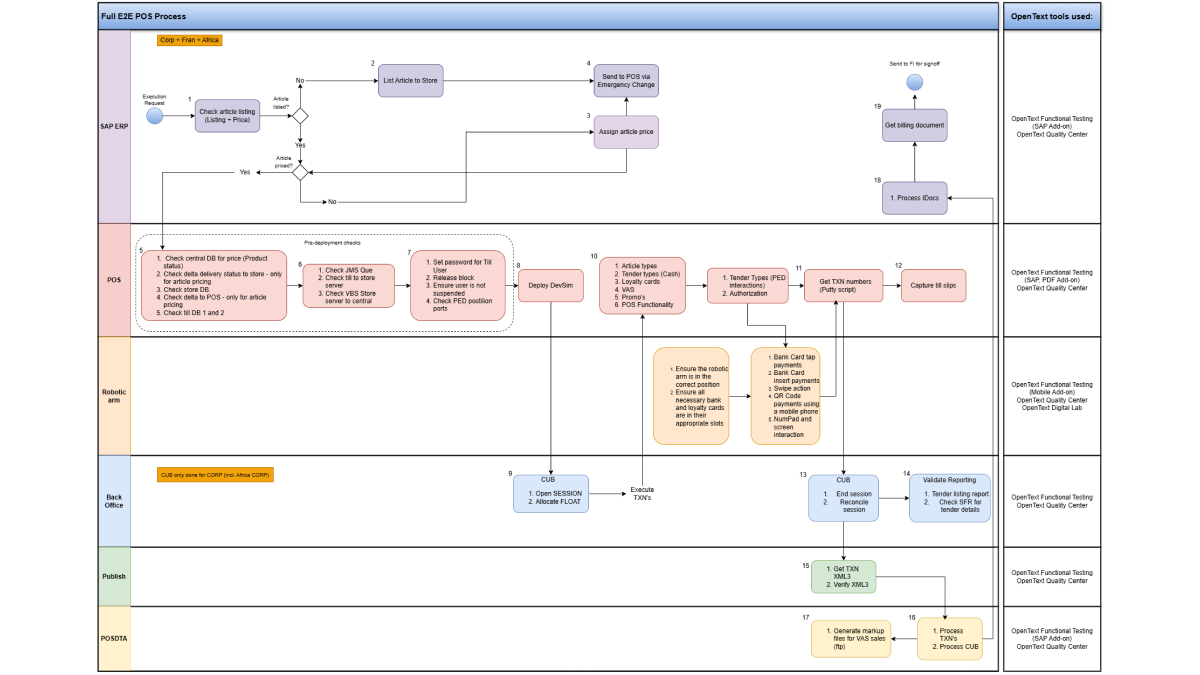
OpenText Functional Testing supports all environments and architectures, enabling seamless end-to-end automation with minimal effort. With one tool and one skill set, teams can optimize processes, create scripts easily.
Results
Pick n Pay’s small team of testers and automation engineers delivered high-volume, efficient POS testing. With nearly 100% automation coverage, they reduced regression cycles to 3.5 days, enabled monthly releases, and cut defects drastically.
A small testing team executing 50,000 automated scripts
The team started with seven or eight members but now consists of one senior software tester and two junior testers focused on point-of-sale testing. In addition, there are seven dedicated automation engineers managing robotic arm (ARM) automation. The team operates with about 17 runtime licenses and 13 full OpenText Functional Testing licenses, enabling each automation engineer to work on up to four virtual machines simultaneously. Despite its small size, the team delivers significant output, executing close to 50,000 automated scripts per week. This efficiency is also supported using OpenText Functional Testing Lab for Mobile and Web, which ensures smooth device management and eliminates latency issues, allowing the team to maintain high performance and scalability.
Nearly 100% automation coverage
The point-of-sale (POS) system now achieves full regression testing within about three and a half days per cycle, which has significantly improved release efficiency. Previously, releases occurred quarterly, averaging four per year, but the process has evolved to allow monthly releases, about twelve per year, and even the capability to release every twelve days if needed.
This improvement is largely due to the robotic arm and automation framework, which runs 24/7 and delivers nearly 100% automation coverage for regression testing. The automation team for POS is now larger than the functional testing team, enabling high-volume execution and reducing manual effort, ultimately driving faster, more reliable deployments into production.
The ROI analysis showed that the robotic arm paid for itself within five months. The total cost for the ARM included engineering, on-site setup, calibration, and installation.
Next steps
Pick n Pay’s approach for improvements is to plan thoroughly, run a small proof of concept to confirm functionality, and once validated, roll it out easily for broader use. Currently they are running a set of proof of concepts:
- First, OpenText Functional Testing for Developer is being used to test APIs and build end-to-end processes that start with mobile app transactions and validate results through backend API calls, with plans to roll it out for the Pick n Pay One app.
- Second, Postman is being leveraged for API calls because developers already use it, and its collections are integrated into OpenText Functional Testing for Developer for fully automated scenarios.
- Third, the ARM is being upgraded to become more dynamic by using OCR to analyze screenshots of the POS screen and adjust its actions, accordingly, supported by a webcam for real-time feedback.
- Finally, the team is exploring AI-driven object recognition in OpenText Functional Testing to identify screen elements from captured images and dynamically click specific areas, adding intelligence to automation for greater flexibility and adaptability. It will reduce maintenance and increase cross-platform efficiency.
Share your story
Learn more



