Why OpenText
Why OpenText
OverviewWhy OpenText
OpenText brings decades of expertise to help you unlock data, connect people and processes, and fuel AI with trust
Manage and connect data
Unify data seamlessly across your enterprise to eliminate silos, improve collaboration, and reduce risks
AI-ready information
Get AI-ready and transform your data into structured, accessible, optimized information
Built-in security and compliance
Meet regulatory and compliance requirements and protect your information throughout its lifecycle
Empowering people
OverviewEmpowering people
OpenText helps people manage content, automate work, use AI, and collaborate to boost productivity
Customers
See how thousands of companies around the world are succeeding with innovative solutions from OpenText
Employees
Our people are our greatest asset; they are the life of the OpenText brand and values
Corporate Responsibility
Learn how we aspire to advance societal goals and accelerate positive change
Partners
Find a highly skilled OpenText partner with the right solution to enable digital transformation
Deploy anywhere
OverviewDeployment options
Explore scalable and flexible deployment options for global organizations of any size
Sovereign cloud
Local control. Global scale. Trusted AI
Private cloud
Unlock the value of the cloud while maintaining control and compliance
On-premises
Maintain full control of your data on your own infrastructure
Public cloud
Protect, scale, and use business information in your cloud of choice
AI leadership
OverviewAviator AI
See information in new ways
OpenText™ Aviator™
AI that understands your business, your data, and your goals
OpenText™ Content Aviator™
Power work with AI content management and an intelligent AI content assistant
OpenText™ Service Management Aviator™
Empower users, service agents, and IT staff to find the answers they need
OpenText™ Software Delivery Aviator™
Enable faster app delivery, development, and automated software testing
OpenText™ Trading Grid™ Aviator™
Unlock AI-powered knowledge, insights, and guided action across your supply chain
OpenText™ Aviator™ Studio
A place where you can build, deploy, and iterate on agents in your data's language
Aviator AI
OverviewAviator AI
See information in new ways
OpenText™ Aviator™
AI that understands your business, your data, and your goals
OpenText™ Content Aviator™
Power work with AI content management and an intelligent AI content assistant
OpenText™ Service Management Aviator™
Empower users, service agents, and IT staff to find the answers they need
OpenText™ Software Delivery Aviator™
Enable faster app delivery, development, and automated software testing
OpenText™ Trading Grid™ Aviator™
Unlock AI-powered knowledge, insights, and guided action across your supply chain
OpenText™ Aviator™ Studio
A place where you can build, deploy, and iterate on agents in your data's language
Business Network
OverviewBusiness Network
Connect once, reach anything with a secure B2B integration platform
Content
OverviewContent
Reimagine knowledge with AI-ready content management solutions
OpenText™ Content Aviator™(AI)
Supercharge intelligent workspaces with AI to modernize work
Cybersecurity
OverviewCybersecurity
Integrated cybersecurity solutions for enterprise protection
DevOps
OverviewDevOps
Ship better software—faster—with AI-driven DevOps automation, testing, and quality
OpenText™ Software Delivery Aviator™(AI)
Elevate millions of developers with AI-powered DevOps experiences
Experience and Fax
OverviewExperience and Fax
Reimagine conversations with unforgettable customer experiences
Legal Tech
OverviewLegal Tech
Make smarter decisions with AI-powered legal software and services
Observability and Service Management
OverviewObservability and Service Management
Get the clarity needed to cut the cost and complexity of IT operations
OpenText™ Service Management Aviator™(AI)
Redefine Tier 1 business support functions with self-service capabilities from private generative AI
APIs
OverviewAPIs
Extend the value of your OpenText solutions by building integrations, automation and custom experiences
OpenText™ API Services
Build it your way with OpenText Cloud APIs that create the real-time information flows that enable custom applications and workflows
Device and Data Protection
OverviewDevice and Data Protection
Protect what matters, recover when it counts
Solutions
Trusted Data & AI
OverviewTrusted Data & AI
Secure information management meets trusted AI
OpenText™ Aviator™ Studio
A place where you can build, deploy, and iterate on agents in your data's language
OpenText™ Discovery
A set of tools to help ingest data and automate metadata tagging to fuel AI
OpenText™ Data Compliance
A suite of services and APIs that make governance proactive and persistent
OpenText™ Aviator™ AI Services
Professional services experts who help you on your AI journey
Information Reimagined
OverviewInformation Reimagined
Get greater visibility and sharper insights from AI-driven information management. Ready to see how?
Knowledge reimagined
Transform daily work with enterprise content management powered by AI
Service Management reimagined
Cut the cost and complexity of IT service management, AIOps, and observability
Connections reimagined
AI-powered B2B integration for supply chain success
Conversations reimagined
Drive value, growth, and loyalty with connected customer experiences
Engineering reimagined
Agile development and software delivery? It only seems impossible
Security reimagined
Cybersecurity for the Enterprise
Decisions reimagined
Unlock insights with AI data analytics
Artificial Intelligence
OverviewAviator AI
See information in new ways
OpenText™ Aviator™
AI that understands your business, your data, and your goals
OpenText™ Content Aviator™
Power work with AI content management and an intelligent AI content assistant
OpenText™ Service Management Aviator™
Empower users, service agents, and IT staff to find the answers they need
OpenText™ Software Delivery Aviator™
Enable faster app delivery, development, and automated software testing
OpenText™ Trading Grid™ Aviator™
Unlock AI-powered knowledge, insights, and guided action across your supply chain
OpenText™ Aviator™ Studio
A place where you can build, deploy, and iterate on agents in your data's language
Industry
OverviewIndustry solutions
Improve efficiency, security, and customer satisfaction with OpenText
Energy and resources
Transform energy and resources operations with cloud, cybersecurity, and AI
Financial services
Boost customer experience, compliance, and efficiency with AI
Government
Reimagine your mission with government-secure information management
Healthcare and life sciences
Improve care delivery and patient engagement with AI-powered solutions
Legal
Modernize legal teams with automated, AI-powered legal tech solutions
Manufacturing
Modernize manufacturing operations and logistics to reduce costs and ensure compliance
Retail and consumer goods
Enhance consumer engagement with omnichannel retail solutions and AI
Enterprise Application
OverviewSolutions for Enterprise Applications
Run processes faster and with less risk

Maximize sustained growth, value, and innovation with intelligent enterprise solutions from OpenText and SAP


Optimize Salesforce effectiveness by bringing together transactional data and unstructured content
Services
Services
OverviewServices
Accelerate digital transformation with guidance from certified experts
Professional Services
Modernize your information management with certified experts
Customer Success Services
Meet business goals with expert guidance, managed services, and more
Support Services
Turn support into your strategic advantage
Managed Services
Free up your internal teams with expert IT service management
Learning Services
Discover training options to help users of all skill levels effectively adopt and use OpenText products
Professional Services
OverviewProfessional Services
Modernize your information management with certified experts
Customer Success Services
OverviewCustomer Success Services
Meet business goals with expert guidance, managed services, and more
Support Services
OverviewSupport Services
Turn support into your strategic advantage
Managed Services
OverviewManaged Services
Free up your internal teams with expert IT service management
Learning Services
OverviewLearning Services
Discover training options to help users of all skill levels effectively adopt and use OpenText products
Partners
Find a Partner
OverviewFind a partner
Find a highly skilled OpenText partner with the right solution to enable digital transformation

Cloud Partners
OverviewCloud Partners
OpenText partners with leading cloud infrastructure providers to offer the flexibility to run OpenText solutions anywhere

Optimize performance and reduce costs with applications deployed on a secure, globally scaled platform

Accelerate migration and modernization with deployment in a highly secure and compliant public cloud
Enterprise Application Partners
OverviewEnterprise Application Partners
OpenText partners with top enterprise app providers to unlock unstructured content for better business insights
Maximize sustained growth, value, and innovation with intelligent enterprise solutions from OpenText and SAP
Optimize Salesforce effectiveness by bringing together transactional data and unstructured content
Partner Solutions
OverviewPartner Solutions
Discover flexible and innovative offerings designed to add value to OpenText solutions
Resources for Partners
OverviewResources for Partners
Discover the resources available to support and grow Partner capabilities
Support
OverviewCustomer Support
Get expert product and service support to accelerate issue resolution and keep business flows running efficiently
Resources
OverviewResources
Explore detailed services and consulting presentations, briefs, documentation and other resources
Choose your region:
Europe, Middle East and Africa
Asia–Pacific
What is incident prevention?
See how AIOps and observability help IT teams prevent incidents, not just react to them

Overview

Incident prevention is the practice of using observability, service context, and AI to stop incidents before they reach users, rather than resolving them faster after the fact.
It rests on four capabilities, each built on the last:
- A trustworthy picture of what exists in the environment
- Observability focused on what matters
- Fast root cause analysis
- Governed automated remediation
Incident prevention
What are the benefits of incident prevention?
- Reduce downtime and MTTR: Catch forming problems early and cut the time spent finding root cause.
- Free up your team: Fewer war rooms and less manual correlation means engineers spend time on higher-value work instead of chasing alerts.
- Harden your security posture: The same change and configuration context that speeds root cause analysis also surfaces unauthorized or risky changes faster.
- Strengthen compliance: Comprehensive logging and audit trails make it easier to demonstrate control over IT changes and incidents.
- Lower the cost of outages: Fewer, shorter incidents mean less revenue impact and less unplanned labor cost.
- Build trust in automation gradually: Governed, human-in-the-loop automation earns the confidence needed to expand autonomy over time.
What are the four layers of incident prevention?
Prevention isn't a single feature. You can't automatically resolve an issue without knowing its probable cause. You can't find probable cause without the right observability data. You can't observe what matters without knowing what exists in your environment and what it supports. Each layer feeds the next.
- Foundation of truth: An always-current, easily queried map of services and their dependencies across applications, infrastructure, and the network, built from discovery and kept clean by AI rather than a manually maintained record. This living service model is what everything else depends on.
- Prioritized, integrated observability: Telemetry scoped to what matters most, based on which assets support which business services. This is where forming problems get flagged before a threshold trips.
- Correlation and root cause: Automated event correlation that reasons across the full context to surface probable cause in minutes, with confidence scores and traceable logic instead of a scatter of separate alerts.
- Automated resolution: Governed runbook and policy-based automation that executes proven remediation at the moment a signal appears, working with the scripts, playbooks, and tools you already run.
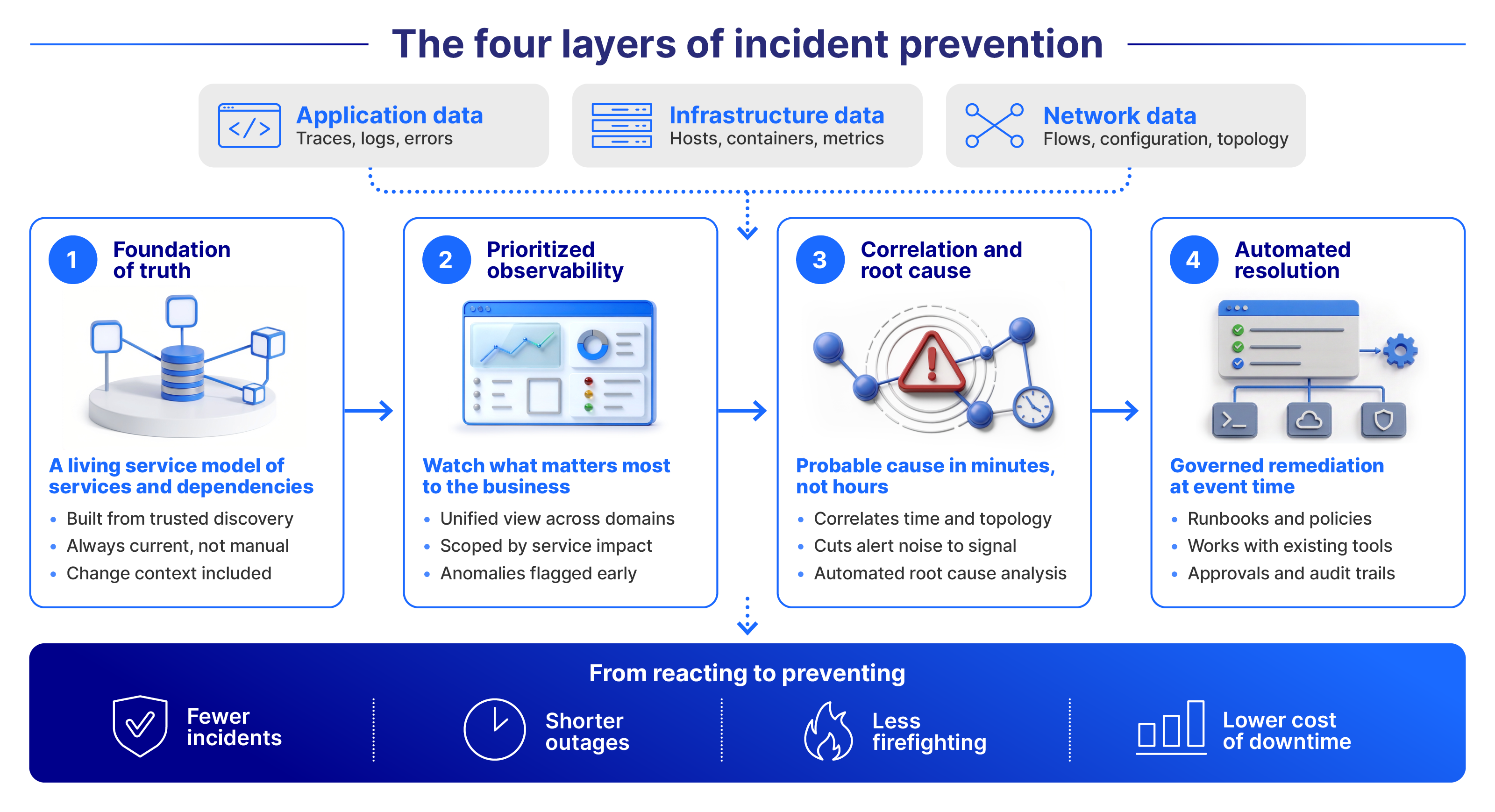
Learn why incident prevention matters
How is incident prevention different from traditional incident response?
Traditional IT operations get graded on MTTR, how fast you recover once an incident hits. That's the wrong measure once a platform can see situations forming, name probable cause in minutes, and act on it under governance. Incident prevention shifts the scoreboard from how fast you clean up to how many incidents and war-room hours you avoid in the first place.
| Traditional Response | Incident Prevention |
|---|---|
| Detect after failure | Detect before impact |
| MTTR focus | Incident avoidance focus |
| Reactive | Proactive |
| Manual investigation | AI-assisted correlation |
What role does AI play in incident prevention?
AI touches every layer of incident prevention, though its role differs by function.
- Detection: Machine learning models flag anomalies and correlate related events into a single picture, catching forming problems before a threshold trips.
- Diagnosis: AI reasons across topology, recent changes, and telemetry to identify probable root cause, often with a confidence score an operator can question and refine.
- Resolution: AI can connect a diagnosis to automation, discovering or authoring remediation steps. Most organizations keep a human in the loop at this stage, expanding autonomy as trust in the system grows.
Maturity varies significantly across platforms, and even within a given platform, AI-driven diagnosis and resolution tend to be further along than fully autonomous detection of problems that haven't triggered an alert yet.
Why does the network matter in incident prevention?
A large share of incidents originate in or transit the network, and root cause analysis has to follow a transaction end to end to be trustworthy. That makes the network a foundational input, not an afterthought behind applications and infrastructure.
It also matters for the automated resolution layer specifically. Safe automated remediation depends on verification, rollback, policy guardrails, drift remediation, and change-plan generation, capabilities that live in network automation. Gartner's Hype Cycle for SRE frames agentic network operations as an enhancement of network automation rather than a replacement, and its execution criteria map directly onto these same capabilities. Put simply, the AI is the reasoning; network automation is what lets it act safely.
What challenges do organizations face building incident prevention?
- Fragmented data: Application, infrastructure, and network telemetry often live in separate tools with no shared context.
- Stale service records: A manually maintained CMDB falls out of date the moment the environment changes, which undermines everything built on top of it.
- Alert fatigue: Without prioritization tied to business impact, teams drown in noise before they can act on what matters.
- Earning trust in automation: Teams reasonably want to see automation work correctly and predictably before expanding what it's allowed to do on its own.
Organizations that work through this well tend to start with the foundation (a current, trustworthy service model) before layering on automation, keep a human in the loop as automation scope expands, and choose tools that integrate with what they already run instead of requiring a rip-and-replace.
How can OpenText help with incident prevention?
OpenText delivers all four layers of incident prevention today, backed by customer results across telecom, financial services, and other industries.
- OpenText™ AI Operations Management unifies observability, correlation, and governed automation across applications, infrastructure, and the network.
- OpenText™ Network Observability brings the network into the same correlated picture, since connectivity and change-driven failures account for a large share of real outages.
- OpenText™ Automation Center executes governed remediation, connecting diagnosis to action.
Resources
Related products
OpenText™ AI Operations Management
Unify observability and automate resolution across your IT estate
OpenText™ Network Observability
Bring the network into the same correlated picture as apps and infrastructure
OpenText™ Automation Center
Govern and execute automated remediation at scale


